HCTE PTE, Ltd.
Blog
  • 12-Station High Voltage Relay Gas Filling, Exhausting and Pipe Cutting Machine | Automated Relay Encapsulation Solution
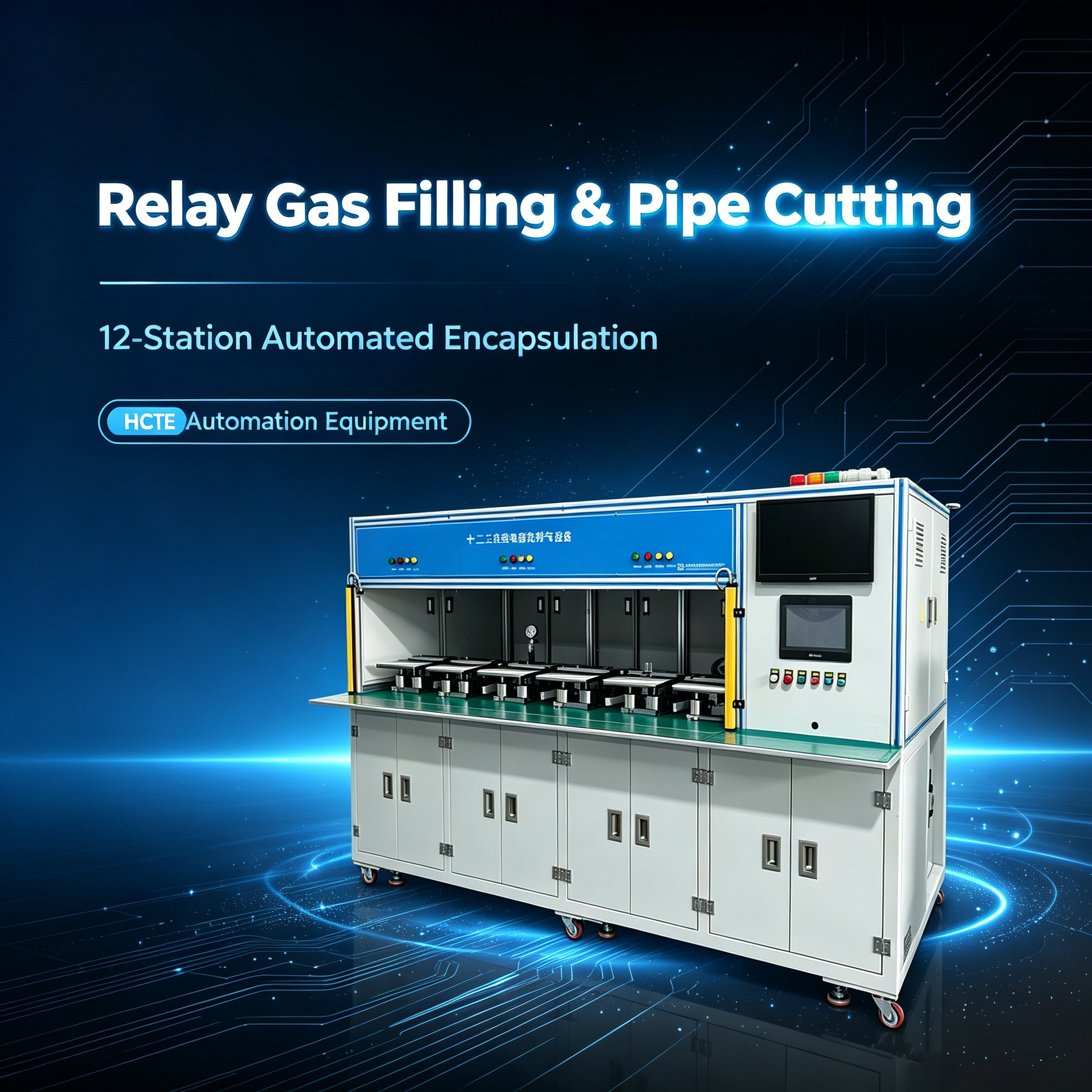
    12-Station High Voltage Relay Gas Filling, Exhausting and Pipe Cutting Machine | Automated Relay Encapsulation Solution Aug 06, 2026
    Introduction: Why Relay Gas Encapsulation and Pipe Cutting Matters High-voltage DC relays are indispensable core components widely used in new energy vehicles, battery energy storage systems, solar photovoltaic stations, and industrial high-voltage control cabinets. Vacuum exhausting, inert gas filling, pressure holding, and pipeline cutting are core precision procedures of high voltage relay encapsulation. These processes directly determine the airtight stability, insulation performance, service life and operational safety of high-voltage relays. Any inaccuracy in high voltage relay gas filling and pipe cutting will cause internal arcing, gas leakage and premature relay failure, seriously affecting the stability of the entire electrical control system. Most traditional relay manufacturing factories still rely on single-station semi-automatic devices or manual operation for high voltage relay gas treatment and pipeline processing. Outdated production methods bring widespread industry pain points: low production efficiency, unstable vacuum and gas filling precision, irregular relay pipe cutting dimensions, and high product defect rates. Unstable batch quality leads to increased labor costs and material waste, failing to meet the strict quality and mass production standards of global new energy and high-end industrial supply chains. With over 13 years of professional experience in precision testing and automation equipment R&D and manufacturing, HCTE independently developed the 12-station automated high voltage relay gas filling, exhausting and pipe cutting equipment. As a high-tech enterprise certified with ISO and CE standards, HCTE focuses on high-precision industrial automation solutions for new energy component manufacturing. This all-in-one relay encapsulation machine integrates vacuum exhausting, precise inert gas injection, constant-pressure leakage testing, fixed-length pipe cutting and cyclic loading and unloading, supporting high-precision, zero-difference and high-volume mass production for high-voltage relay post-processing. Core Performance & Technical Advantages That Benefit Manufacturers 1. 12-Station Rotary Cyclic Operation, Ultra-High Mass Production Capacity Different from traditional single-station relay gas filling and cutting equipment that can only execute one single process at a time with long idle waiting time, HCTE’s exclusive rotary platform adopts a 12-independent-station cyclic design tailored for high voltage relay processing. Each station independently completes full-process operations including workpiece loading, high-vacuum exhausting, precise inert gas filling, constant-pressure holding leakage detection, precision pipe cutting and finished product unloading without mutual interference. The entire equipment supports 24-hour uninterrupted continuous operation, achieving fully automated streamlined relay encapsulation. This optimized structural design maximizes production beat utilization, greatly shortens single-piece processing cycles and significantly improves daily production output. It perfectly adapts to large-scale batch production demands of modern high-voltage relay factories, thoroughly solving the capacity bottleneck of traditional relay processing equipment. 2. High-Precision Gas Control System, Stable Airtight Performance & Ultra-Low Defect Rate Internal gas purity and cavity tightness are the core criteria for evaluating high-voltage relay quality. Insufficient vacuum exhausting and uneven gas filling easily cause internal oxidation, arc discharge and long-term gas leakage failure of relays. This professional high voltage relay gas filling machine is equipped with imported high-precision pressure sensors and intelligent constant-flow control modules, supporting flexible and precise adjustment of vacuum degree, filling pressure, gas flow rate and pressure holding time to match different relay model specifications and production standards. Adopting HCTE’s exclusive post-pressure-stabilization cutting process, the equipment only performs automatic pipe cutting after the relay cavity pressure and gas purity reach stable qualified standards. This standardized processing method completely eliminates quality risks such as residual air, impure inert gas and insufficient sealing caused by manual operation. It stably guarantees consistent relay airtight performance in mass production and effectively reduces product rework and scrap rates for relay manufacturing lines. 3. Precision Fixed-Length Pipe Cutting Mechanism, 100% Batch Dimension Consistency Manual cutting and ordinary pneumatic cutting tools cannot ensure machining accuracy, often resulting in uneven cutting notches, inconsistent reserved pipeline lengths and burr defects. These common problems in traditional relay pipe cutting processes lead to poor assembly matching, increased assembly difficulty and frequent secondary rework, seriously restricting production efficiency and product yield. Equipped with a self-developed high-rigidity mechanical precision cutting mechanism, HCTE’s relay pipe cutting equipment delivers ultra-high positioning accuracy and stable cutting strokes. All relay pipelines achieve flat, burr-free cuts and unified fixed-length dimensions in batch production. The standardized precision cutting process optimizes subsequent assembly procedures, greatly improves overall production yield and realizes unified high-quality standards for large-scale high-voltage relay manufacturing. 4. Intelligent Recipe Storage & Visual HMI, Reduce Labor Dependency & Downtime The equipment is equipped with an industrial-grade visual HMI human-machine interaction system, realizing real-time dynamic monitoring of station operating status, process parameter data, production output and equipment fault information. The intuitive and simple operation interface lowers operator learning thresholds and effectively avoids human misoperation during high voltage relay gas filling and cutting procedures. It supports one-key storage, calling and switching of multiple customized process recipes. Manufacturers can directly call preset parameters for different high-voltage relay models without repeated debugging and calibration, greatly shortening model switching time and improving production flexibility. Equipped with a sound-light integrated alarm system, the equipment can timely feed back abnormal faults, helping technical teams quickly troubleshoot problems and reduce production line downtime losses for relay encapsulation production. 5. Industrial-Grade Safety & Durable Structure, Long-Term Stable Factory Operation Tailored for long-term continuous industrial production scenarios, this automated relay encapsulation machine adopts a full-range safety light curtain protection system. It triggers an immediate emergency stop once personnel or foreign objects enter the working area, ensuring 100% on-site operation safety. The fully closed dust-proof and anti-corrosion cabinet structure features stable mechanical performance and ultra-low failure rate, adapting to harsh workshop environments for long-term continuous high voltage relay processing. Matched with adjustable support feet and heavy-duty mobile casters, the equipment supports flexible workshop layout adjustment and convenient daily maintenance. Strictly manufactured in accordance with HCTE’s ISO9001 quality management system, the equipment achieves a one-time inspection pass rate of over 99.7%, ensuring stable 24-hour continuous operation, reducing post-maintenance costs and improving production continuity for high-volume relay production. Application Industry & Processing Scope HCTE’s automated relay gas treatment and pipe cutting equipment is professionally customized for high-precision encapsulation of high-voltage DC relays. It is widely applicable to vacuum exhausting, inert gas filling, airtight leakage detection and fixed-length pipe cutting processes for new energy vehicle high-voltage relays, energy storage system high-power relays, photovoltaic power generation relays and industrial DC high-voltage relays. As professional relay vacuum gas filling equipment, it is core automation equipment for upgrading quality and efficiency in relay post-encapsulation processes. Replacing traditional manual and semi-automatic production processes, this automated solution helps relay manufacturing enterprises realize standardized, intelligent and efficient production. With mature overseas project experience covering Europe, Asia, Africa and other regions, HCTE assists global new energy component manufacturers in improving product competitiveness in the international market. Conclusion With the continuous upgrading of global new energy industry standards, high-voltage relays have put forward higher requirements for airtight stability, batch consistency and service life. Traditional manual and semi-automated production processes can no longer meet the high-end procurement standards of global new energy and industrial brands. Upgrading to 12-station fully automated high voltage relay gas filling and pipe cutting solutions has become an inevitable choice for relay manufacturers to reduce costs, stabilize quality and improve production efficiency. HCTE’s automated relay gas exhausting and pipe cutting solution precisely solves core industry pain points including insufficient production capacity, unstable gas filling precision, inconsistent pipe cutting sizes, high defect rates and high labor costs, helping manufacturing enterprises complete intelligent upgrading of relay precision encapsulation processes. If you are looking for high-stability, high-yield and high-efficiency automated solutions for high-voltage relay gas filling and pipe cutting, welcome to contact HCTE for professional process consultation, technical verification and customized production line matching services.
  • HCTE invites you to attend the 2025 Bangkok Auto Parts Exhibition | Booth V25, empowering the future of automobile intelligent manufacturing with precision testing technology
    HCTE invites you to attend the 2025 Bangkok Auto Parts Exhibition | Booth V25, empowering the future of automobile intelligent manufacturing with precision testing technology Mar 26, 2025
    Deeply cultivating the core links of automobile intelligent manufacturing, HCTE will appear at the Southeast Asian industry event with innovative testing equipment   Dear industry partners and customers: As the global automotive industry accelerates towards intelligence and greening, HCTE, a pioneer brand of H&H Group focusing on automotive testing technology, is using innovation to protect the quality of every car. From April 3 to 5, 2025, we will explore the future code of automobile manufacturing with you at booth V25 of the Bangkok Auto Parts Exhibition (TAPA 2025).   Why choose HCTE? Because we know that the precision of each screw is related to safety; the strength of each weld carries trust.   Highlights of HCTE booth: Using technology to interpret the "zero defect" commitment Airtightness test equipment: Building an invisible barrier for safety   Showing the world's leading multi-station airtightness detection system, covering key components such as new energy battery packs, fuel systems, cooling systems, and headlights, with a detection accuracy of 0.1Pa, helping you achieve "watertight" quality control.   Four-station automotive compressor hydrogen and nitrogen leak detection equipment   Vacuum chamber helium leak detection equipment: Redefining precision manufacturing standards The fully automatic helium mass spectrometry leak detection solution designed for high value-added parts is suitable for precision components such as motor housings and sensors. The leak rate detection sensitivity is increased to 10⁻¹² mbar·L/s, providing "microscope-level" quality assurance for automotive core components.   Battery housing vacuum chamber helium leak detection equipment   Motor performance test bench: The efficient heart that drives future travel   From torque, temperature rise to energy efficiency ratio, HCTE's integrated motor test platform can be customized to adapt to various new energy motors, and the data acquisition speed is increased by 30%, helping customers shorten the R&D cycle and reduce trial and error costs.   Performance test equipment for winch reducer   Intelligent detection of welding process: making every weld a work of art Combining visual recognition and laser sensing technology, real-time monitoring of welding strength and deformation parameters, eliminating the hidden dangers of false welding and leaking welding, and injecting "smart genes" into safety.   Eight-station automatic brazing machine   Why TAPA 2025 should not be missed?   The largest stage in Southeast Asia: Thailand accounts for 33% of the ASEAN automotive market share. The TAPA exhibition attracts more than 20,000 professional buyers, covering vehicle manufacturers, first-tier suppliers and after-sales markets.   Green transformation outlet: The Thai government plans to increase the proportion of electric vehicle production to 30% by 2030, and the demand for testing equipment has surged. HCTE technology precisely meets the needs of industrial upgrading.   Efficient docking opportunities: Booth V25 is located in the core exhibition area of ​​BITEC, adjacent to the main forum area, making it convenient for you to participate in the concurrent technical summit and dialogue with industry leaders.     Exhibition information: Time: April 3-5, 2025 | 9:00-18:00 Location: BITEC Exhibition and Convention Center, Bangkok, Thailand (88 Bangna-Trad Road) Booth: V25 We are ready and look forward to your arrival!
  • The future of all-solid-state battery vehicles: How does helium leak detection technology unlock new heights of safety and endurance?
    The future of all-solid-state battery vehicles: How does helium leak detection technology unlock new heights of safety and endurance? Mar 11, 2025
    All-solid-state battery cars: no mileage limit, a new driving force for future travel All-solid-state battery cars use solid electrolytes to replace the liquid electrolytes in traditional lithium-ion batteries, and store and release electrical energy through the migration of lithium ions between the positive and negative electrodes. This new type of battery uses solid conductive materials, which fundamentally solves the safety hazards of liquid electrolytes.     Why is helium leak detection the "safety gatekeeper" of all-solid-state batteries?   Although all-solid-state batteries use solid electrolytes instead of flammable liquid materials, minor defects in the battery packaging process may still cause gas leakage or moisture intrusion, causing performance degradation or even safety hazards. Helium (He), as an inert gas, has extremely small molecules (only 0.26 nanometers in diameter) and can accurately detect micron-level leaks. It is the "gold standard" for detecting battery air tightness.     The automatic helium inspection machine for automotive parts developed by HCTE uses a high-precision helium mass spectrometer leak detector, which can complete the battery pack sealing test within 10 seconds with a sensitivity of up to 5×10⁻⁸ mbar·Ls. By simulating complex working conditions such as vibration and temperature changes during vehicle driving, the equipment ensures that each battery meets the IP67 protection standard before mass production, completely eliminating the risk of "a thousand-mile dam collapsed by an ant hole".     HCTE Helium Inspection Machine: The Key Driver of Mass Production of All-Solid-State Batteries The commercialization of all-solid-state batteries faces two major bottlenecks: high interface impedance and high manufacturing costs. HCTE's automated helium inspection technology is breaking through from the following dimensions: 1. Cost reduction and efficiency improvement: Traditional helium inspection relies on manual operation, which is inefficient and has a high error rate. HCTE equipment supports fully automatic assembly line integration, with a 300% increase in inspection efficiency. A single device can inspect up to 500,000 sets of batteries per year, helping automakers to quickly achieve large-scale production. 2. Extend life: By accurately locating and repairing micro-leakage points, the battery cycle life is increased by more than 20%, directly reducing users' "battery anxiety".   3. Compatible with future technologies: Whether it is a sulfide electrolyte or an oxide system, the HCTE helium inspection machine can be adapted, providing "zero compromise" quality assurance for the development of next-generation solid-state batteries.   Data speaks: How does helium leak detection rewrite the rules of the game in the industry? Safety improvement: The fire accident rate of battery packs equipped with HCTE helium detectors has decreased by 95%. Endurance optimization: After the airtightness meets the standard, the battery energy loss is reduced by 8%, and the endurance mileage has steadily exceeded 800 kilometers.   Customer case: After a leading car company adopted HCTE equipment, the battery recall rate dropped by 92%, and the annual cost savings exceeded 200 million yuan.     The future has come: In 2030, how will all-solid-state batteries change your travel? Industry forecasts show that all-solid-state batteries will occupy 30% of the new energy market in 2030, and helium leak detection technology will become the "invisible engine" of this process. As the world's leading leak detection solution provider, HCTE has reached strategic cooperation with various battery manufacturers. Its modern automatic helium detector has introduced blockchain traceability technology to "chain" the detection data of each battery and provide users with a lifetime warranty certificate.       Act now: If you are looking for the best solution for battery leakage detection, or want to learn more about the technical details of HCTE automatic helium inspection machine for automotive parts and get customized solutions, please contact our engineering team for consultation - there is no need to compromise between safety and efficiency!
  • How to perform a "physical examination" on a relay ceramic housing? How helium inspection technology can help auto parts manufacturers seize opportunities
    How to perform a "physical examination" on a relay ceramic housing? How helium inspection technology can help auto parts manufacturers seize opportunities Mar 08, 2025
    An industry earthquake caused by a "leak" In 2023, a well-known electric vehicle brand in Southeast Asian countries was forced to recall thousands of new cars due to the failure of the high-voltage DC relay seal - the reason was a micro-crack on the ceramic shell that was invisible to the naked eye. This lesson worth millions of dollars made the entire industry realize: "Invisible loopholes are the biggest risks."   As the new energy vehicle industry in Southeast Asian countries soars (Thailand aims to produce 725,000 electric vehicles in 2030), manufacturers of high-voltage DC relays are facing a dual challenge: not only to meet the stringent requirements of the 800V high-voltage platform, but also to control costs and seize the market. The airtightness of the ceramic shell, as the "armor" of the relay, directly determines the product life and safety.   1. Why do high-voltage DC relays have to "stick to" ceramic housings? 1. Survival rules in the high-voltage era The 800V high-voltage platform has become the mainstream trend of electric vehicles, with larger currents and more intense heat generation. Traditional plastic housings are prone to deformation and aging, while ceramic housings have become rigid demands due to their high temperature resistance (>1000℃), strong insulation and long life.   But hidden dangers are hidden in the details: tiny pores or welding residues during the ceramic sintering process may cause hydrogen leakage, which may cause relay malfunction or battery thermal runaway.   2. The "blind spot" of traditional testing The embarrassment of water testing: the housing needs to be dried after the immersion test, which may introduce moisture corrosion risks.   Limitations of pressure testing: only large leaks can be detected, and micro leaks of ≤10⁻⁶ mbar·l/s are helpless - this is equivalent to leaking a sesame-sized helium every year.   Industry truth: 90% of ceramic housing failure cases are due to "nano-level vulnerabilities" that traditional testing methods fail to detect.   2. Helium inspection technology: the scientific magic that makes the "invisible killer" nowhere to hide Imagine: helium is like a group of well-trained "scouts", and the helium detector is their command center.   1. Ultra-sensitive "leak detection" principle Molecular penetration: The diameter of helium molecules is only 0.26 nanometers, which can drill into the 0.1 micron defect of the ceramic shell.   Accurate tracking: The helium mass spectrometer is like a "gas radar", which can detect leak rates as low as 5×10⁻¹⁰ mbar·l/s (1000 times more sensitive than traditional methods).   Non-destructive testing: No need to contact liquid, avoid shell contamination, especially suitable for the cleanliness requirements of high-voltage DC relays.   Case report: After a supplier in Jakarta, Indonesia introduced an automatic helium detector, it successfully passed the German Rhine TÜV certification, won orders from European car companies, and increased its annual export volume by 200%.   3. Automatic helium inspection machine: "efficiency-enhancing and burden-reducing magic weapon" for Southeast Asian factories For Southeast Asian manufacturers who are sensitive to labor costs, the value of this equipment is far more than "quality inspection" - it is also an invisible engine for profit growth.   1. Speed revolution: faster than cooking a bowl of Vietnamese rice noodles Multiple vacuum boxes are used for parallel inspection, and the time for a single piece is ≤15 seconds. More than 2,000 pieces can be inspected in 8 hours.   The code scanning traceability system automatically associates production batches, and the source of quality problems is located in 30 seconds.   2. Helium circulation: saving real money Helium prices fluctuate violently (the increase in 2024 is more than 30%), but through the 95% recovery rate design, a single device can save about 80,000 US dollars in helium costs per year - enough to add another production line!   3. Flexible intelligent manufacturing: one machine for multiple uses The modular design is suitable for ceramic shells of different sizes, from high-voltage DC relays for new energy vehicles to charging pile seals, and can be quickly changed in 5 minutes.   Intelligent pressure regulation (0.1-1.0MPa) matches a variety of test scenarios.   Future vision: When helium inspection machine meets AIoT Intelligent prediction: Through machine learning, analyze historical data and reduce the defect rate. Cross-border collaboration: Real-time remote generation of optimization solutions based on inspection data.   In the trend of "high voltage" and "fast charging" in electric vehicles, every tiny crack in the ceramic housing may cause the company's hard-earned brand reputation to collapse. An automatic helium inspection machine is not only the "gatekeeper" of quality, but also the "golden key" of the relay product line.
  • New Product! Automotive Filter Testing Equipment
    New Product! Automotive Filter Testing Equipment Jan 20, 2022
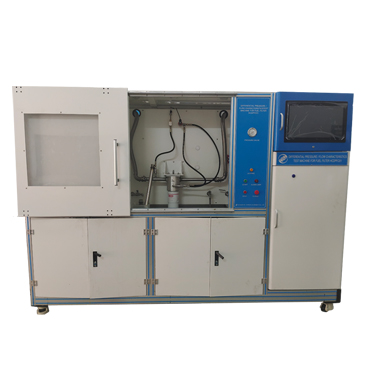
    The testing equipment of automobile filter is oil filter test and air filter test respectively. According to the ISO test standard of filter, we make a complete set of scheme test equipment. Oil filter static pressure burst resistance tester Testing machine for filtering efficiency and ash capacity of oil filter Oil filter differential pressure flow characteristic tester Structural integrity verification and initial bubble point test bench Air filter test bench Filter element damage resistance test bench Filtration efficiency and impurity storage of automotive engine diesel filter and gasoline filter
  • Automobile Seat Test Equipment
    Automobile Seat Test Equipment Jan 20, 2022
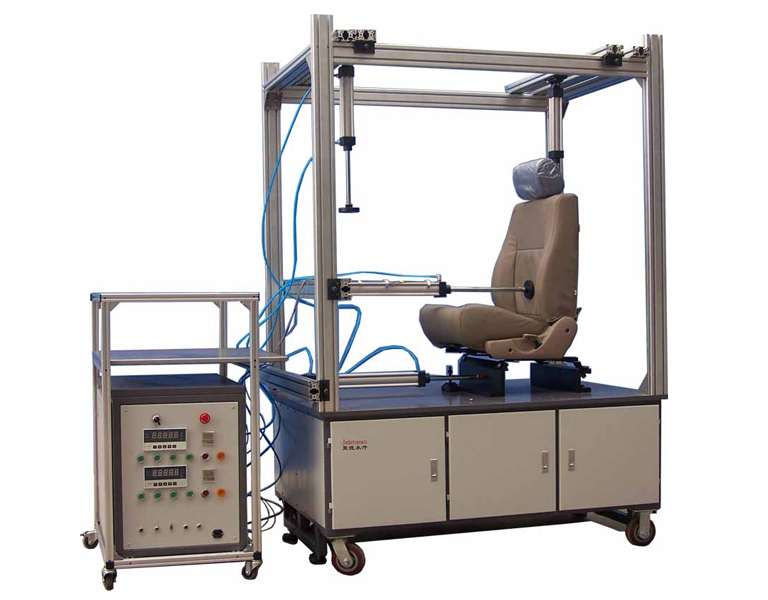
    2021 is the first year of the rise of new energy vehicles. The global intelligent vehicle market maintains rapid growth, "intellectualization" has become the most important development idea of the industry. At present, the automobile industry is no longer a state of clear boundaries, and the trend of intelligent and lightweight automobile seats has become an irreversible inevitable trend. Automobile seat detection has also become an important product of detection equipment. We have relevant car seat test equipment, welcome to consult, can be customized according to customer needs.
  • How to Do Structural Integrity Verification and Bubbling Point Test with a Machine
    How to Do Structural Integrity Verification and Bubbling Point Test with a Machine May 24, 2022
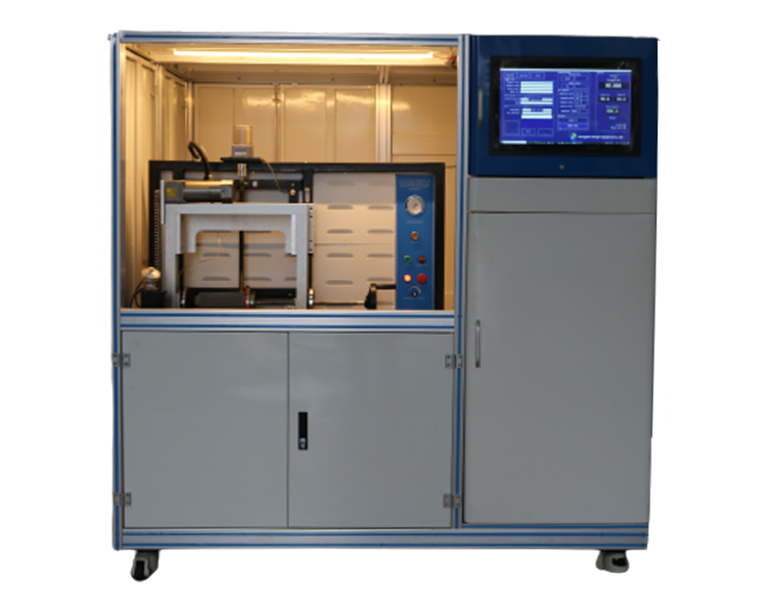
    When we want to do a structural integrity verification and bubbling point test for hydraulic filters, we may want to do it by a machine automatically. Then a test stand complying with ISO 2942-2004 may be suitable for doing the test.It specifies a bubble-point test method for confirming the manufacturing dependability of your filter factor or figuring out the localization in the most significant pore in the filter factor by figuring out the first bubble point. Verification of manufacturing dependability specifies the acceptability in the filter aspects for additional use or tests. The first bubble noint is recognized throuah continuation in the manufacturing intearity testIt is under no conditions an operating sign of a filter element in specific. It cannot be employed for extrapolation for the ideas of purification ranking, performance or maintenance capacity and really should be used for details only.
  • Test Methods of Air Tightness Test Equipment for Testing Condenser of Auto Air Conditioner
    Test Methods of Air Tightness Test Equipment for Testing Condenser of Auto Air Conditioner Jun 01, 2022
    If we want to test a condenser of auto AC, a helium gas detection system or an air tightness test equipment is needed to do the test. But how does it works? Here are the methods of testing car condenser:   1.Large leak detection: After the vacuum holding chamber front door is shut down, the machine successively functions tough and great pumping of the vacuum holding chamber before the vacuum level inside the holding chamber reaches the set leak detection stress. Once the vacuum holding chamber is evacuated, the machine fills the test part inside the holding chamber rich in-stress gas of three.5MPa (downward changeable), after which keeps the strain, waiting around for the strain sensing unit of the system to ensure whether there is a huge leak. If there is a huge leak inside the check part, the machine will discharge our prime-stress gas inside the check part, close the suction control device of the vacuum holding chamber at the same time, and terminate the leak detection method. And right after filling the vacuum holding chamber into the environment, the proprietor presses the verification option, the entrance of the vacuum holding chamber will automatically available, utilizing the check part out, marking and putting it into the to-be-handled place. When the system fails to find a huge loss of the check part, it would automatically carry out the subsequent leak detection method.   2.Vacuum the test part: If no huge loss of the check part is available, the machine will release our prime-stress gas inside the check part and vacuumize the inside of the check part. Once the vacuum level inside the check part reaches the set stress worth, wait for the evacuation technique of the vacuum holding chamber to accomplish.   3.Vacuum helium detection: Once the evacuation of the vacuum holding chamber reaches the set leak detection stress, and at the same time the evacuation of the check part inside the holding chamber continues to be finished, the machine detects the helium sign inside the detection container and suppresses this sign to absolutely nothing. Then load the test part with 4.0Mpa (downward changeable) helium gas. Once the helium gas stress inside the check part reaches the set worth, the leak detector will detect the loss of the check part.   When the leak detector locates a helium sign that surpasses the set worth, this means that there is a tiny leak inside the check part inside the holding chamber and also the system will problem a leak alarm system. The proprietor presses the verification option, and also the vacuum holding chamber will automatically be opened up right after simply being loaded with the climate. After the proprietor divides the fast connector from the check part, the test part may be taken off and designated consequently.   When the leak detector fails to find a helium sign that surpasses the set worth, this means the detected check part has no loss. The program sends a signal that goes by the detection, and automatically functions the helium rehabilitation method in the check part.   4.Helium rehabilitation: After the assessment is completed, the helium inside the check part is sent back to the very low-stress helium aquarium through automated stress harmony. Once the helium stress inside the check part falls to atmospheric stress, the machine works with a vacuum pump to recuperate the remainder helium inside the check part. Once the stress inside the check part falls to the set worth, the helium recovery process is completed. Whilst recouping helium, the machine fills the vacuum aquarium with environment. Once the stress of the vacuum container rises to atmospheric stress and also the helium recovery process of the check part inside the holding chamber continues to be finished, the entrance of the vacuum holding chamber is automatically opened up and also the detection method is completed.  
  • What Does a Alternating Salt Spray Laboratory Do
    What Does a Alternating Salt Spray Laboratory Do Jun 08, 2022
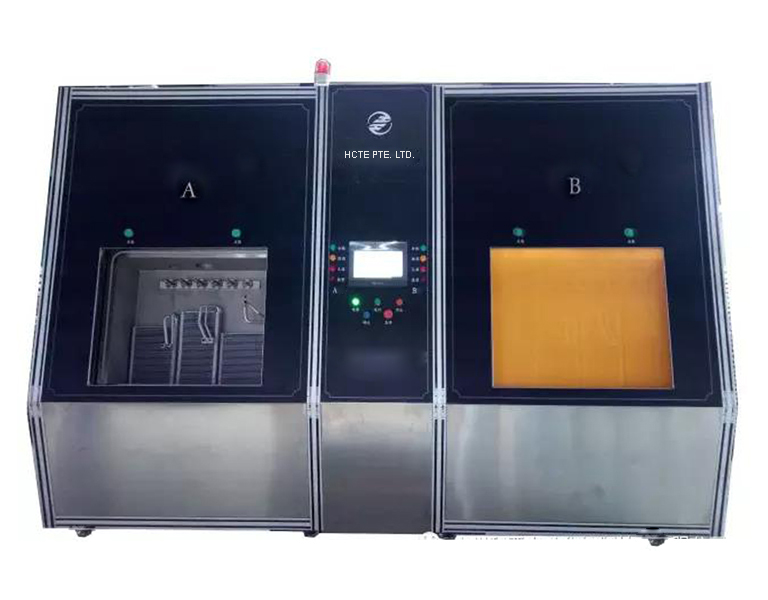
    Salt spray testing is widely used in many manufacturing industries. For example, in automobile industry, power battery, automobile assembly and parts must resist salt spray corrosion. Therefore, factories producing those products must do the salt spray test to make sure that the product reach the qualification.   The salt spray test is normally done by a test machine. There are many kinds of machines can do the salt spray test. One of them is called alternating salt spray laboratory. It can simulate marine climate and assess the salt spray corrosion resistance of specimen and their protective layer. The alternating salt spray laboratory is complied with ISO12405-3:2014.   There will be three stages of the testing process: A. It will spray salt spray at 15℃ to + 35℃ for 2 hours. B. Then when the temperature reaches (40 ± 2) ℃ and relative humidity reaches (93 ± 3)%, placed the specimen for 20 to 22 h. C. After that, when the temperature reaches (23 ± 2) ℃ and the relative humidity is 45% to 55%, placed the specimen for 3 days. Stage A and stage B are one cycle, repeating 4 cycles and then proceed stage C to form a test cycle and completing 4 test cycles at the test.  
  • A System Doing Tests of IPX1-8
    A System Doing Tests of IPX1-8 Jun 15, 2022
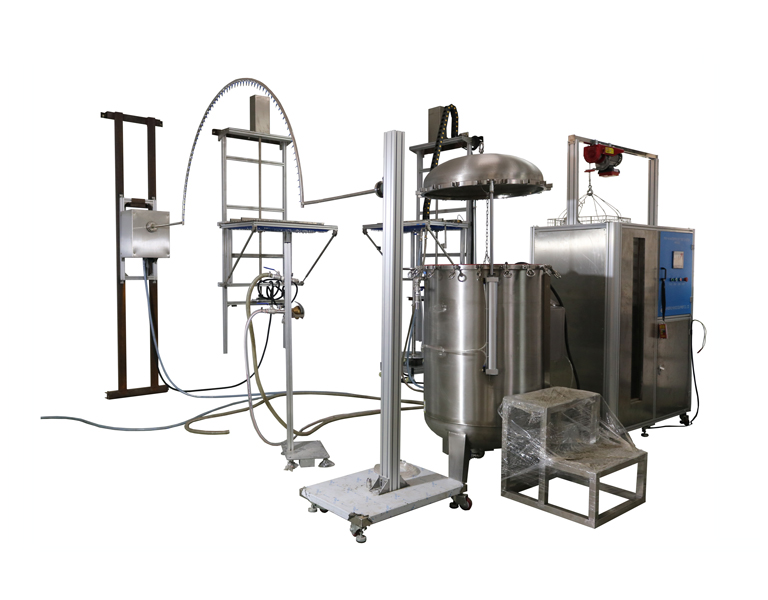
    Normally when doing water resistant test with a machine, one machine could only do one or two tests, like IPX1 only or IPX5 and IPX6 at the same time, but here is a system can handle water resistant test from IPX1 to IPX8. IPX1-8 water-resistant test program consists of top to bottom drip rain evaluating equipment, oscillating tubing tester for IPX3 and IPX4, apply nozzle, handheld jet nozzle, smart normal water provide and manage program, IPX8 normal water tightness strain tester and tiltable turning phase. 
  • Testing Batteries of Cars
    Testing Batteries of Cars Jun 20, 2022
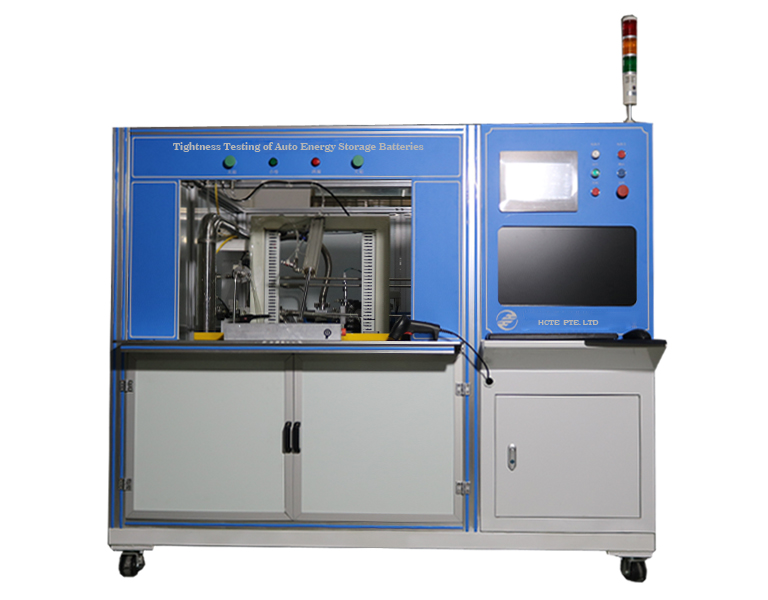
    These days electrical vehicles are becoming popular among people. The most important part of the electrical car is its battery. Therefore the safety of the battery must be ensured. There are several tests for the battery. One of them is the tightness test. The machine to this test is called Tightness Testing of Automotive Energy Storage Batteries. This equipment is a helium sensor for the steel casing battery following the shot hole is covered and welded. It mainly includes operations including battery checking, feeding, evacuation, helium stuffing, helium examination, and unloading. The helium sign in the problem recognition cavity is detected with the helium problem sensor, that may assess the leakage of the workpiece quickly and accurately rich in accuracy and precision.
  • Test Chamber for Electrotechnical Products is Hot Selling!
    Test Chamber for Electrotechnical Products is Hot Selling! Jun 25, 2022
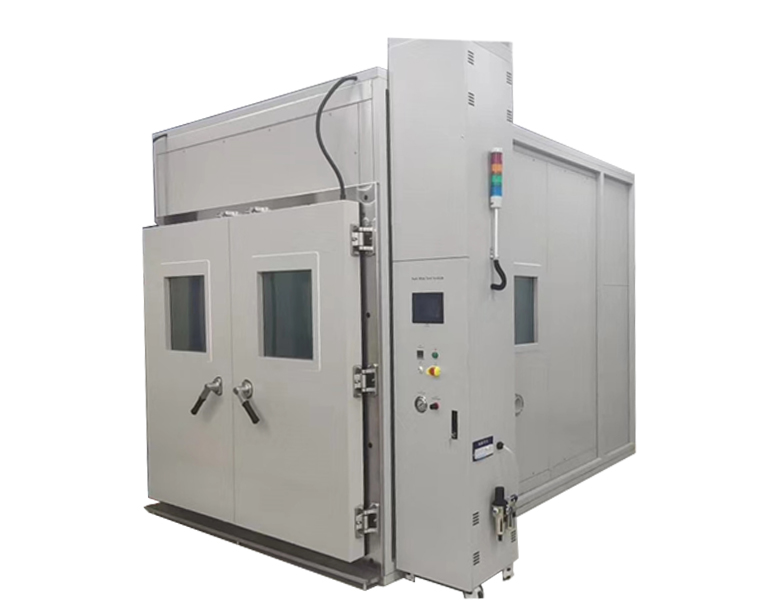
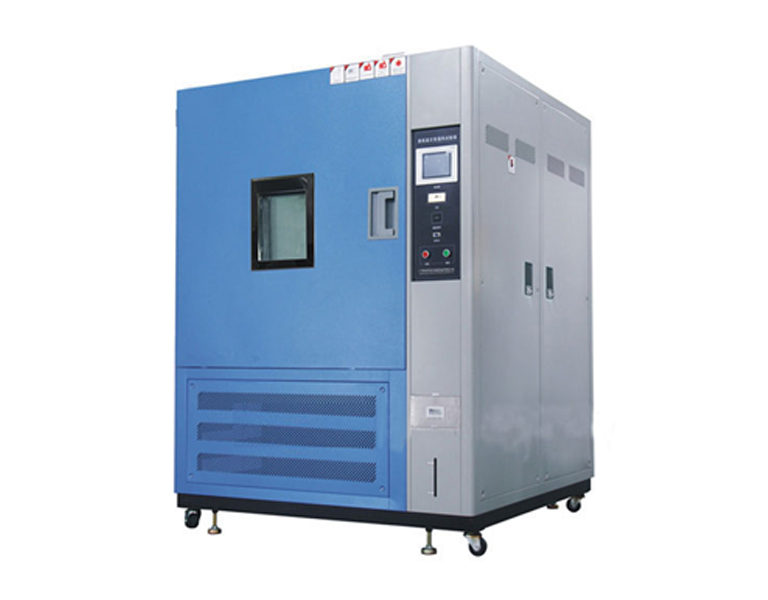
    Some electrotechnical products are needed to be tested if they can resist high and low temperature alternating at certain humidity before they are sold. It is one kind of environmental test. Then a High and Low Temperature Alternating Damp Heat Test Equipment, which is a kind of climate chamber or environmental chamber, is needed.The cooling, low temperatures, constant temperatures and humid temperature of the products give you the necessary cooling capability. Based on the distinct test claims of the products, the refrigeration method will automatically learn to supply cooling capability for the related test method, to be able to match the functionality crawl of the products.
1 2

A total of2pages

:
Committed to the research and development, manufacturing and sales of laboratory testing instruments and production line testing systems
Get a free quote

leave a message

leave a message
If you are interested in our products and want to know more details,please leave a message here,we will reply you as soon as we can.

Home

Products

whatsApp