Helium Mass Spectrometry Leak Detection for Automotive Aluminum Die-Cast Housings: Solving the Challenge of Detecting Micro-Leaks
Oct 08, 2026
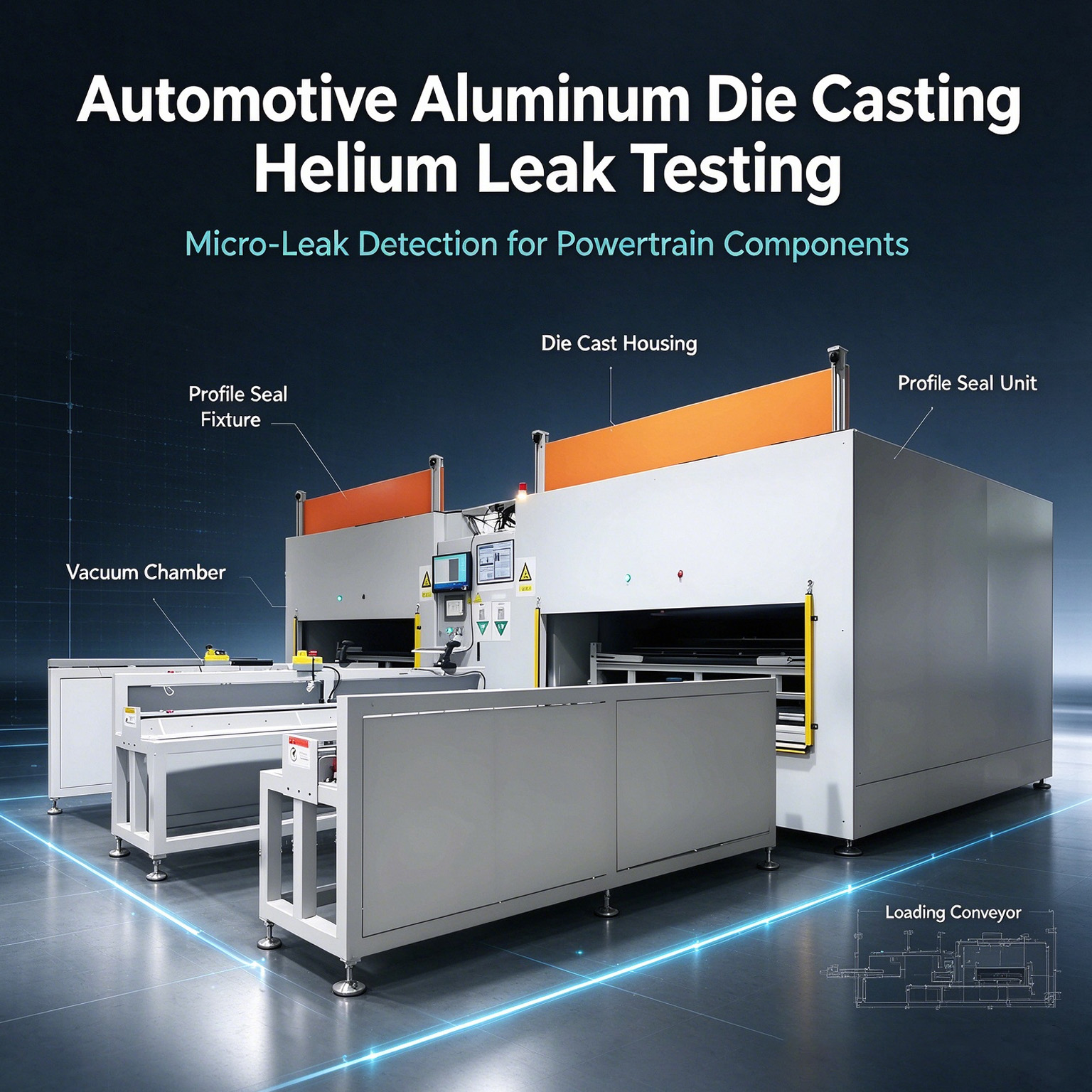
Automotive aluminum die-cast components—such as engine blocks, transmission housings, and electric motor casings—represent some of the most challenging parts to test for leaks. Micro-sand holes, pinholes, and porosity in weld seams—inherent to the die-casting process—often result in micron-level micro-leaks. Traditional pressure decay methods lack the necessary precision to detect these, leading to missed leaks and subsequent post-sales failures involving oil or coolant leakage.
Thanks to its ultra-high sensitivity, helium mass spectrometry leak detection has become the core technology for the final inspection of automotive die-castings. Drawing on HCTE’s practical experience with domestic automotive aluminum housing leak detection projects, this article breaks down the key technical aspects and optimization methods for helium testing these components.
Three Major Industry Pain Points in Aluminum Die-Cast Housing Leak Detection
Complex Shapes and Multiple Interfaces: Housings feature complex structures with numerous sealing points—such as mounting holes, process holes, and oil passages—making it difficult to achieve a seal using universal tooling.
Helium Adsorption on Inner Walls: The porous, loose structure of the die-casting's inner walls adsorbs helium during testing and releases it slowly afterward, potentially causing "false positive" readings for the next workpiece.
Balancing Mass Production Cycle Times with Precision: Automotive production lines operate at high speeds, whereas helium testing—while highly precise—is typically slower; a balance must be struck between the two.
HCTE’s Systematic Solution: A helium leak detection system developed by HCTE for a domestic automotive supplier, featuring multiple specialized optimizations tailored to the characteristics of die-cast components:
Modular System Architecture with Imported Core Components: The system is divided into independent functional modules—such as vacuum pumping units, leak detection units, and tooling control units—facilitating maintenance and scalability. Core components utilize industry-proven configurations; high-precision, industrial-grade vacuum gauges and leak detectors ensure detection accuracy and long-term stability at the hardware level.
Contour-following sealing tooling with rapid changeover design:To accommodate the complex, multi-port, and irregular geometries of the castings, the system employs custom contour-following sealing heads and flexible clamping mechanisms. This ensures reliable sealing without damaging the workpiece's machined surfaces. It supports mixed-model production with a changeover time of ≤10 minutes, meeting the testing requirements for the client's diverse range of housing products.
Helium desorption compensation routine to reduce false positives: To address the issue of helium adsorption on the inner walls of castings, the test sequence has been optimized. This includes extending the post-test nitrogen purge duration and implementing a staged helium-clearing logic to thoroughly remove adsorbed helium. Following these optimizations, the production line's false-rejection rate dropped from 8% to 0.7%, significantly reducing unnecessary rework.
Optional sniffer probe positioning module: For defective parts, a portable sniffer probe system can be used to rapidly pinpoint leak locations. This data is fed directly back to the die-casting process to optimize parameters, establishing a closed-loop quality control system.
Project Outcomes:
The system reliably detects micro-leaks at the 1×10⁻⁸ Pa·m³/s level, fully meeting the sealing requirements for automotive powertrain components. Since deployment, the equipment has maintained an operational stability rate exceeding 99.5%, helping the client reduce post-sales complaints related to housing leaks by more than 90%.
Tip: When performing helium leak testing on die-castings, the tooling and helium-clearing routines are just as critical as the testing unit itself. Equipment selected solely based on the unit's precision—while overlooking process compatibility—often suffers from persistently high false-rejection rates after deployment.